The Custom Cafe Photo Booth: 3 Installs Doing It Right
Creative Inspiration
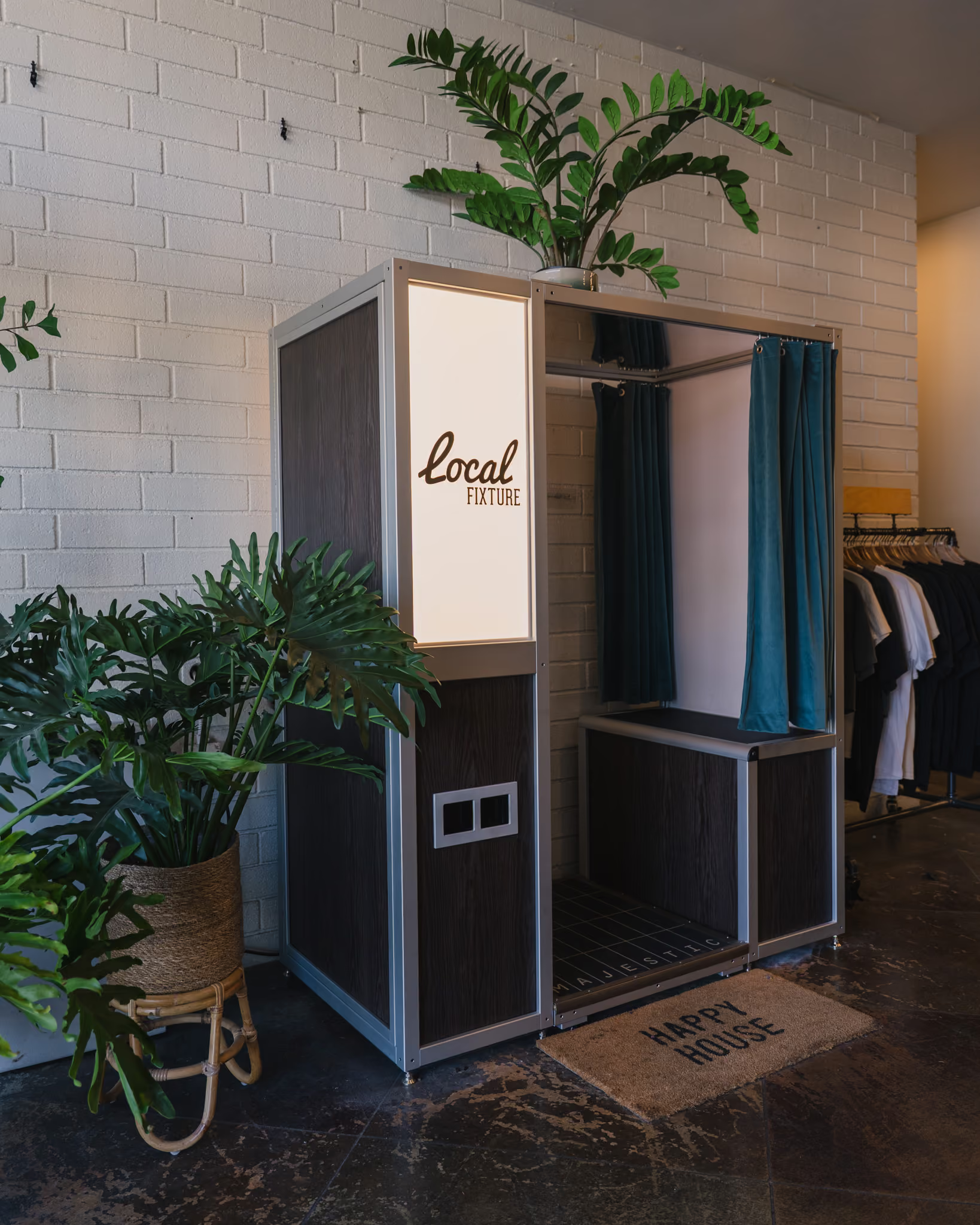
A custom cafe photo booth, installed and serviced at no cost through Majestic's venue placement program. See the builds at Local Fixture, Cherry Bomb, and Blue Hour Coffee.
Almost everyone starts this question in the same place, and it is the wrong place. They take their guest count, divide it by some number they half remember, and get an answer that is either wildly over budget or quietly guarantees a forty minute queue.
Guest count is an input. It is not the starting point. Here is what actually decides it.
If you want a number before you read the rest here it is and rough estimates. One enclosed booth comfortably serves about 150 to 200 guests over a four hour event. Past roughly 250 guests in that window, a second booth stops being a luxury and starts being the difference between a feature and a bottleneck.
But that rule of thumb hides three variables that matter more than the headcount does, and at a festival it breaks completely.
A photo booth does not serve individual guests. It serves sessions. And the relationship between the two changes enormously depending on what kind of event you are running.
At a wedding, the booth is one of several things competing for a guest's evening. Some people use it three times, plenty never use it at all.
At a brand activation where the booth is the "activation," nearly everyone who walks up wants in, and you are limited purely by how fast the machine can cycle.
At a festival drawing tens of thousands, total attendance tells you almost nothing. Sixty five thousand people attending does not mean sixty five thousand people want a photo strip. What matters is how many are in front of your booths during the busy hours, and how long they are willing to wait.
Three genuinely different problems.
1. Throughput, or sessions per hour per booth. For an enclosed booth shooting a short sequence and printing on site, plan on 30 to 35 sessions per hour sustained. You can hit 40 in a burst with a disciplined queue and an attendant moving people along, but you cannot hold that for four hours. Groups take longer than couples. People fix their hair. Somebody always wants to see the strip before they leave. So that number is really an estimate.
2. Average group size. Two to three people per session at a coffee shop or a bar. Three to four at a festival or a party where friends pile in together. This number quietly doubles your effective capacity, which is why enclosed booths outperform single person setups on throughput per square foot.
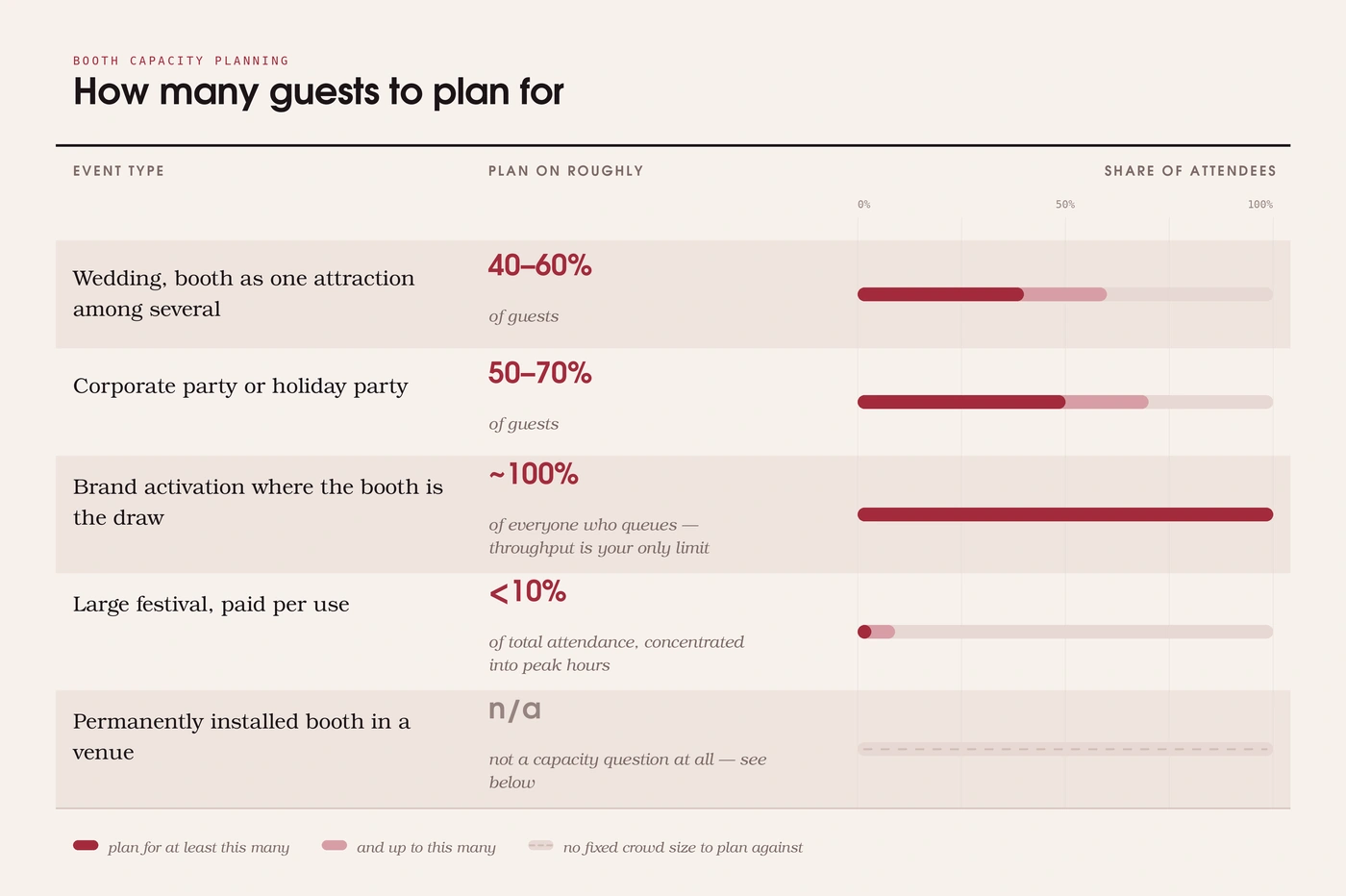
3. Capture rate, or what share of attendees will actually use it. The number nobody estimates and everybody gets wrong. These are planning starting points, not laws. Adjust them for your crowd.
Sessions you need = (guests x capture rate) divided by average group size
Sessions one booth can deliver = open hours x sessions per hour
Booths = the first number divided by the second, rounded up.
Worked through for a 400 person corporate party running four hours:
One booth covers it, with almost no margin. If the party skews social, or the booth is positioned somewhere prominent, or people come back for a second go, you are short. At 400 guests this is the exact size of event where we would talk you through whether one is genuinely enough.
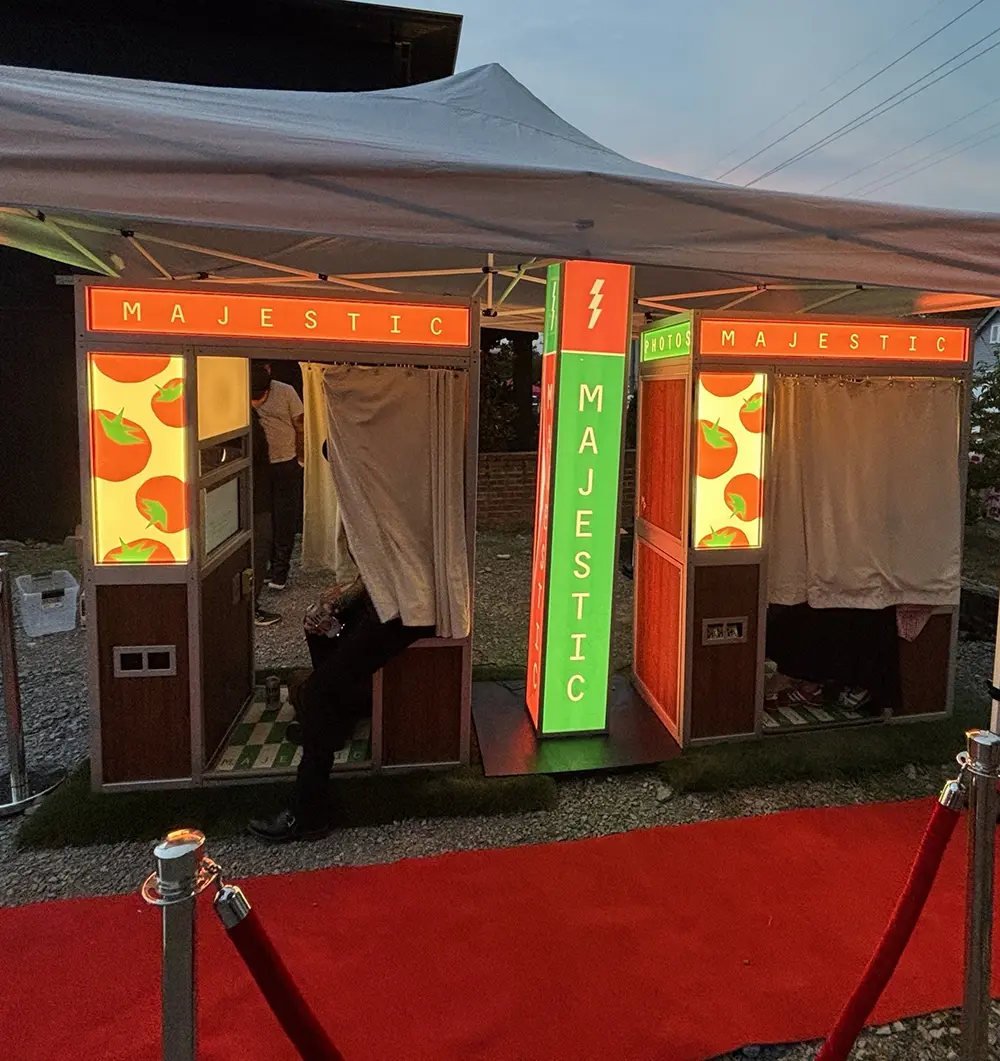
We put four booths into Tomato Art Fest in East Nashville this month. The festival draws tens of thousands of people across two days. Four booths is not remotely enough capacity to photograph that crowd, and it was never meant to be.
At a festival you are not sizing for attendance. You are sizing for queue length during peak hours, and the queue is self regulating: people join it if it looks fun and short, and walk past if it looks long. Add booths beyond that point and you get idle machines. Add too few and the queue becomes a wall that turns people away, which costs you the sessions you were trying to capture.
Four worked because they sat as a bank under one tent with a shared rope line, so the queue fed whichever booth opened next. That detail matters more than the count. Four booths in one queue have meaningfully higher throughput than four booths scattered across a site, because no individual booth ever sits empty while people wait somewhere else. If you are spreading booths across a large footprint for coverage, size each location separately, because each becomes its own independent queue.
Our guide to festival installations goes further into distribution, staffing and restocking across a big site.
{{button}}
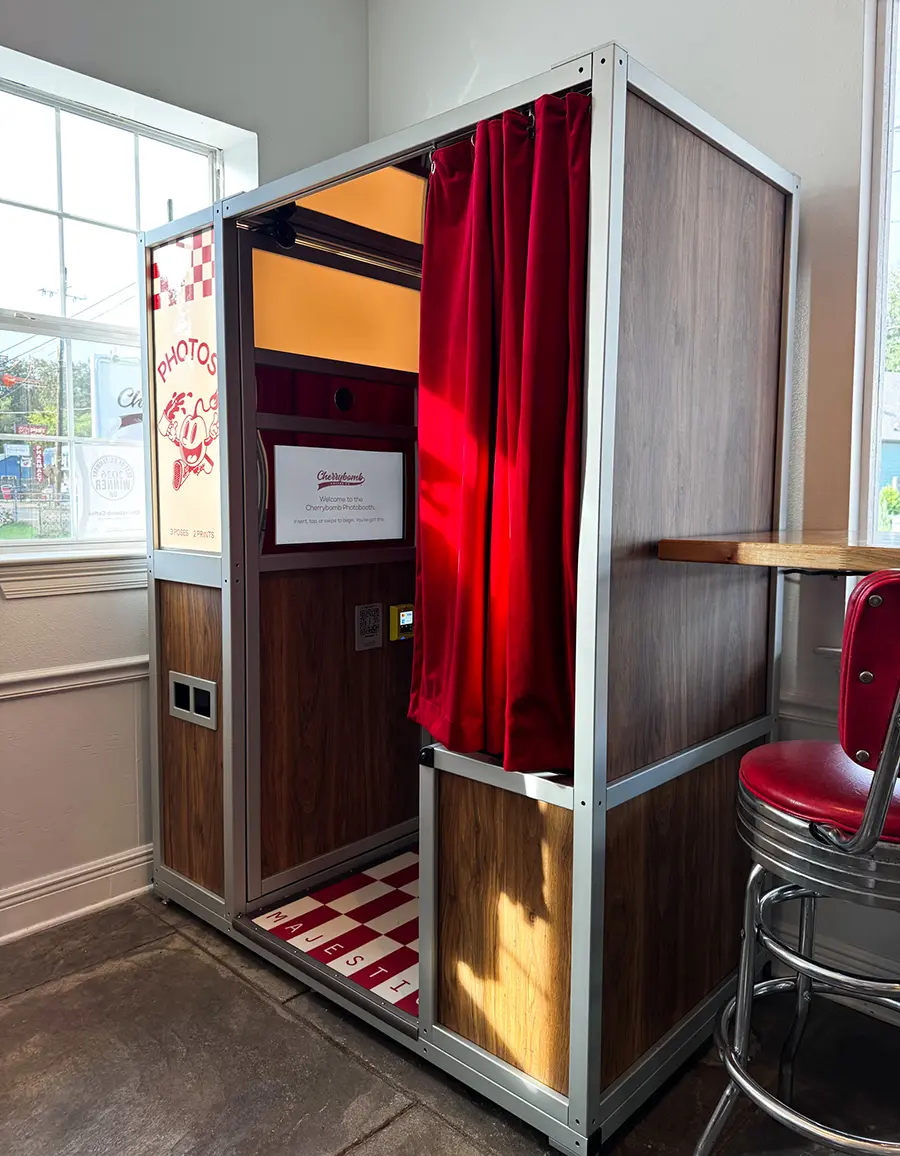
At the other end, our booth at Cherrybomb Coffee Co. in Madisonville, Louisiana is a single Classic booth in a coffee shop that opens at half six in the morning.
It does not need a second unit and never will, because it has no peak. Usage spreads across eleven hours: someone waiting on an order, teenagers after school, a family on Saturday morning. Low peaks, very long tail. A permanently installed booth is almost never a capacity question. It is a dwell time question, and one booth answers it.
The lesson generalises. Capacity problems are peak problems, not volume problems. An event serving 800 people across ten hours needs less hardware than one serving 400 in two.
Decide up front what wait you consider acceptable, because it changes the answer.
Ten minutes is fine at almost any event. People will happily stand ten minutes for something with a curtain and a print at the end. Twenty minutes and you start losing groups. Thirty and the queue becomes a deterrent, and the people who walk away are usually the ones who would have posted the photo.
Divide your peak hour demand by your throughput and you get your real queue. If that number is over about fifteen minutes at the busiest point, add a booth. If it is under five for the whole event, you have overbought.
A common instinct is to solve capacity with one bigger or faster unit. Usually two booths beat one for the same footprint of thinking, for reasons that have nothing to do with speed.
Redundancy is the big one. Printers jam. It happens to every booth ever made, and with a single unit a jam means your feature is dark until somebody fixes it. Two booths means a jam is an inconvenience instead of an outage.
Two also lets you split behaviour. One as the main queue, one placed somewhere quieter for people who do not want an audience. And two shorter queues simply look more inviting than one long one, which lifts your capture rate before anyone has taken a photo.
Attended or unattended. An attendant is worth several sessions an hour, purely by keeping the line moving and resetting between groups.
Number of prints per session. Every extra print adds cycle time. Two prints per session is the sweet spot for most events: one to keep, one to give away.
Outdoors. Heat, weather delays and daylight all slow a booth down. Build in margin.
Space. Two booths need two footprints plus queue room. Check the dimensions and the setup requirements against your floor plan before you commit to a number, not after.
How many photo booths do I need for 500 guests? For a four hour event, two. One booth delivers roughly 88 sessions in that window, and 500 guests at a typical capture rate need around 100. Two gives you comfortable headroom plus redundancy.
How many photo booths for 1,000 guests? Two to three for a four hour event, depending on how central the booth is to the programme. If it is the main attraction rather than a side feature, three.
How many people can a photo booth handle per hour? Around 30 to 35 sessions per hour sustained, which at three people per session is roughly 60 to 75 people. Higher in short bursts with an attendant.
Is one photo booth enough for a wedding? For most weddings under 200 guests, yes. Above 250, a second booth is worth it, mostly to remove the risk of a single printer problem taking your only booth offline during the reception.
Do more booths mean more photos? Only up to the point where your queue clears. Past that you are paying for idle machines. Size to your peak hour, not your total attendance.
Should the booths be together or spread out? Together, if capacity is the goal. A shared queue feeding several booths beats separate queues every time. Spread them only when you are covering a large site and want presence in more than one place.
Tell us your guest count, how long the doors are open, and whether the booth is the main attraction or one of several things going on. We will tell you honestly what you need, including when the answer is fewer booths than you were expecting.
We handle brand activations nationwide, and we would rather size it properly than sell you a fourth booth that spends the evening empty.
{{button}}
.webp)
.webp)
Discover how Majestic Photobooth can enhance your venue with our customizable photo booth solutions. Contact us now!
