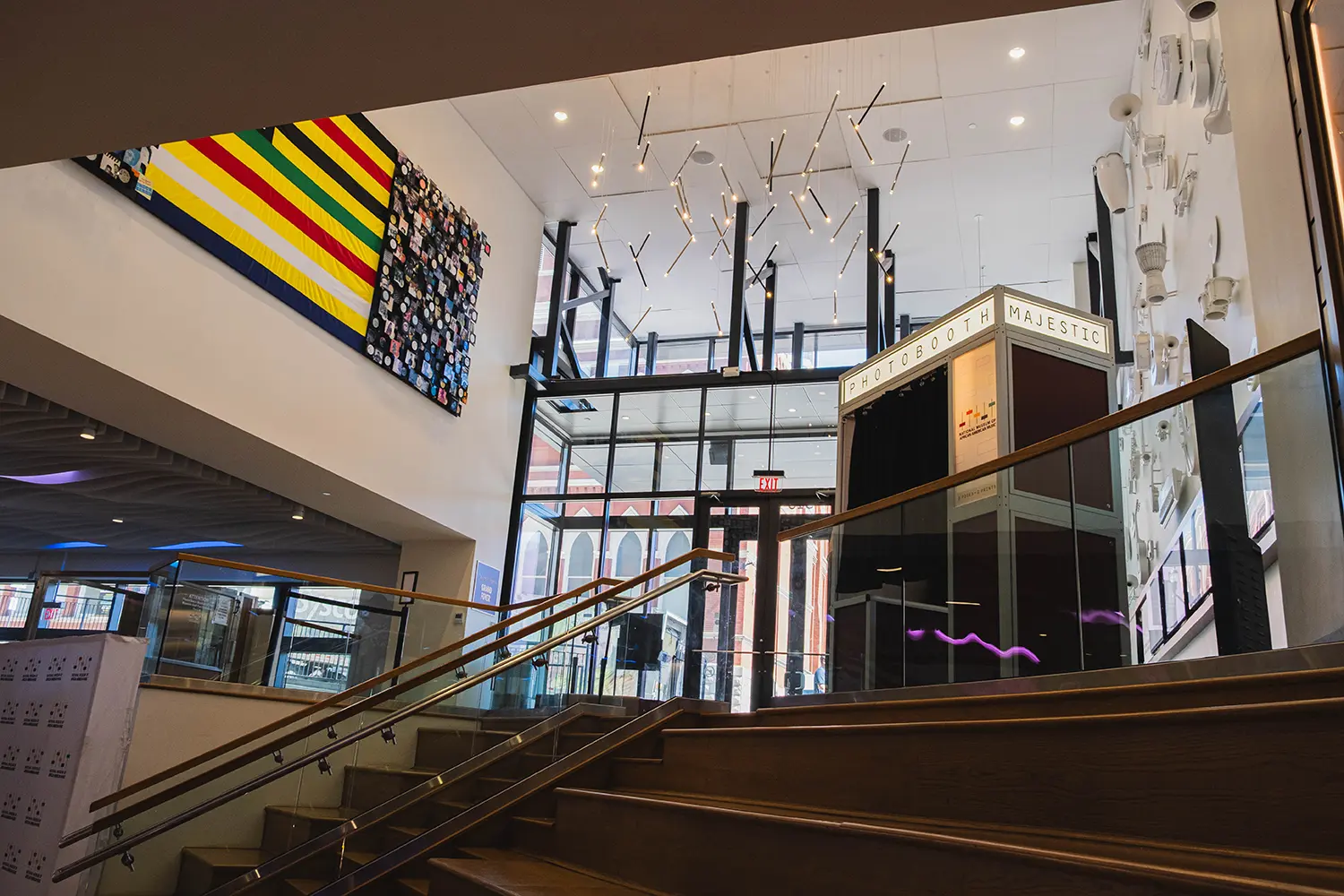
There is a wall in the Grand Foyer covered in instruments. A banjo, a trombone, a saxophone, congas, a trumpet, several guitars, a violin, a turntable. Perhaps thirty of them, mounted across a double height wall, every one finished in flat white.
Our booth stands directly in front of it, at the top of the stairs.
Where a booth goes is usually the least discussed decision in a placement and very often the one that determines everything else. At NMAAM it was the whole conversation when we partnered through our venue placement program.
The landing
The museum opened in January 2021 at Fifth and Broadway in downtown Nashville, with its entrance on John Lewis Way. It covers more than fifty genres and subgenres of music created and shaped by African Americans, and it is the only museum in the country dedicated to that history.
Our booth is not in a gallery. It sits on the landing at the top of the Grand Foyer stairs, against the instrument wall, with a glass balustrade in front of it and a full height window onto Broadway behind.
That position does three things at once.
It is on the route rather than off it. Everybody climbing those stairs is walking toward it, and everybody coming back down passes it again. Nobody has to be told where it is or make a decision to go and find it.
It is in the circulation, not in the interpretation. A booth placed inside a gallery would be competing with the thing it is standing next to. On the landing it is clear of all of that, and the museum's own material keeps the floor to itself.
And it is visible from below. The marquee is lit and reads across the room from the bottom of the stairs, which means the first time most people see it they are forty feet away and have not yet decided anything.
That last one is why the booth sits where it does rather than tucked against a side wall. In a monumental room the worst thing a booth can be is discreet.
Two Nashville booths, opposite instincts
We have another booth about a mile from here, at Old Glory in Edgehill, and it is the inverse of this one in every respect.
At Old Glory the booth is set into the space beneath a staircase. The printer is concealed. Nothing reads as a machine from outside the curtain. The room is a converted boiler building with a dramatic, low lit interior, and the right answer there was to let the booth disappear into the architecture and be found.
Here the answer was the exact opposite. Top of the stairs instead of underneath them. Lit marquee instead of no signage. Prominent instead of hidden.
Same city, same company, same month in some cases, and two placements that look like they were decided by different people. They were not. They were decided by two different rooms.
A bar at night is a space you explore. People wander, they find things, and discovering a booth tucked under a stair is part of why it is good. A museum foyer in daylight is a space you move through, usually with a ticket in hand and somewhere to be. Nobody is exploring the foyer. So the booth has to announce itself in the few seconds it has, or it does not get used.
If there is one thing we would want a venue to take from this post, it is that. The placement is not a detail to settle after the design. It is the first decision and it changes everything after it.
What we did not put on it
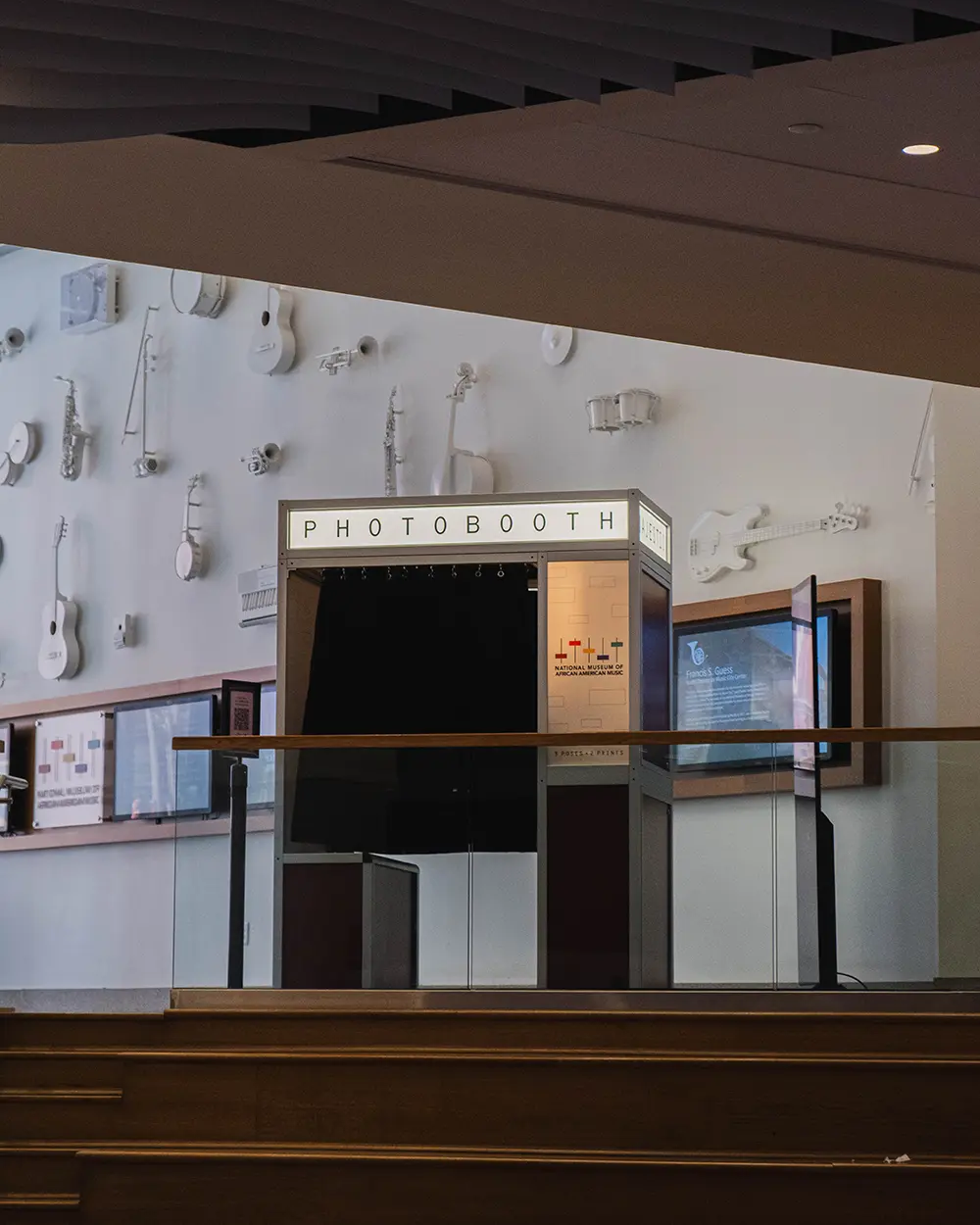
This booth carries almost no graphics.
Brushed aluminum frame, deep burgundy woodgrain panels, black velvet curtain on grommet rings, and a lit marquee reading PHOTOBOOTH along the front with MAJESTIC turning the corner. The only institutional mark anywhere on it is the museum's logo on a backlit side panel, with 3 POSES • 2 PRINTS underneath. That is the entire graphic treatment.
That was deliberate, and it is a different call from the one we made at the Museum of Fine Arts, Boston, where we built a booth for the Hallyu exhibition that was covered in the artists the show was about and printed strips in the Korean style. That was the right answer for a temporary exhibition with a strong visual identity and a fixed run.
NMAAM is permanent, and the foyer is already doing a great deal of work. A booth covered in interpretation would be one more surface to read in a room that has a thirty piece instrument wall, a commissioned textile, a donor wall and a bank of screens in it.
So the cabinet is just a cabinet, in materials that belong to the century of music upstairs rather than to this one. Photo booths entered American public life in the 1920s and spent the following decades in drugstores, arcades, bus stations and five and dimes. The machine is roughly contemporary with a good deal of what the galleries cover. It did not need a costume to belong in this building.
Underneath it is our Classic booth, customized to the room rather than picked off a list. If you want this level of detail and customization in your own space get in touch with us.
{{button}}
Why it is a placement
NMAAM did not buy a photo booth, and this is what our Venue Placement program is built for.
No capital, no hardware on the institution's books, and nobody on the front of house team thinking about paper, ribbon or a jam on a Saturday. We designed it with them, they approved the direction before anything went into production, we installed it, and we run it. Monitoring, maintenance and service sit with us.
It also came with ninety days to prove it belonged on that landing. That is our Earn Its Space Guarantee: if a placement has not shown the value we agreed, we optimize it, move it, or take it out. We would rather move a booth than defend a bad spot for it.
We work with institutions through our museum partner program, alongside our booths at the Brooklyn Museum Corner Shop and MFA Boston.
Common FAQ
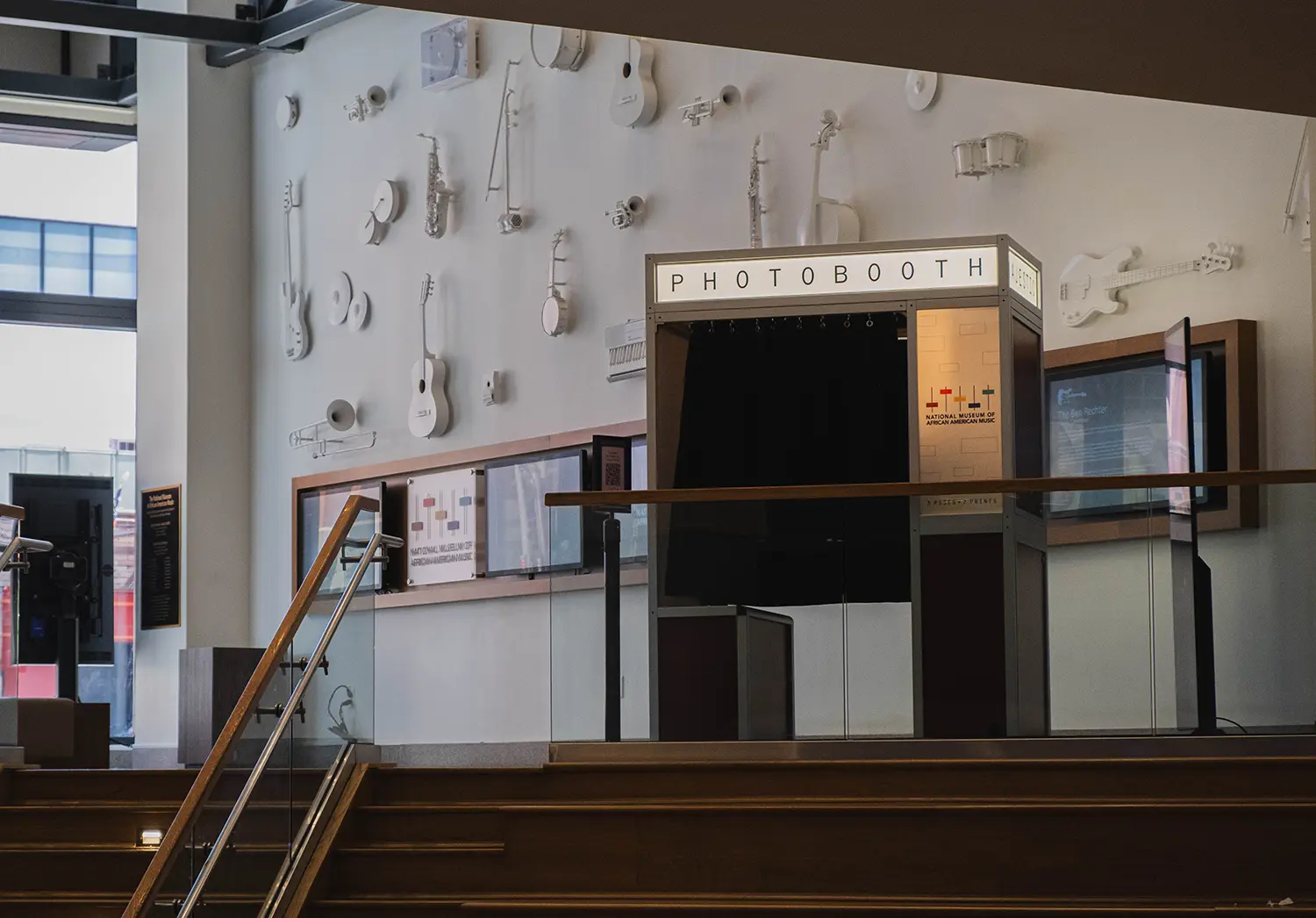
Where is the photo booth at NMAAM? On the landing at the top of the Grand Foyer staircase, in front of the instrument wall. You pass it on the way up to the galleries and again on the way back down.
How many photos do you get? Three poses, two prints. One to keep and one to give away.
Do you need a museum ticket to use it? The booth is inside the museum, so access follows whatever the museum's own admission policy is. Check with NMAAM.
Did the museum have to buy the booth? No. It went in through our Venue Placement program, which means no capital outlay and no hardware on the institution's books. We design it with them, build it, install it and run it.
Who maintains it? We do. Monitoring, maintenance, paper and service sit with Majestic. Nobody on the museum's team has to think about it.
How long does it take to get a booth into a venue? Two weeks from final design approval and confirmed site readiness to Go-Live. The design conversation before that moves at whatever pace the venue wants.
Can any museum or attraction get one? Not every building suits a booth and we would rather say so early. What matters is steady visitor flow, a spot on the route rather than off it, enough light and enough space for three people, and somebody at the institution who owns the decision. If it fits, there are ninety days to prove it belongs.
Want one in your building?
We design and build custom photo booths for the room they are going into and install them through our Venue Placement program, with maintenance handled by us. We also run brand activations nationwide.
If you run a museum, an attraction or anywhere people arrive with a ticket, tell us about the room and where people stop in it.
{{button}}
.webp)
.webp)