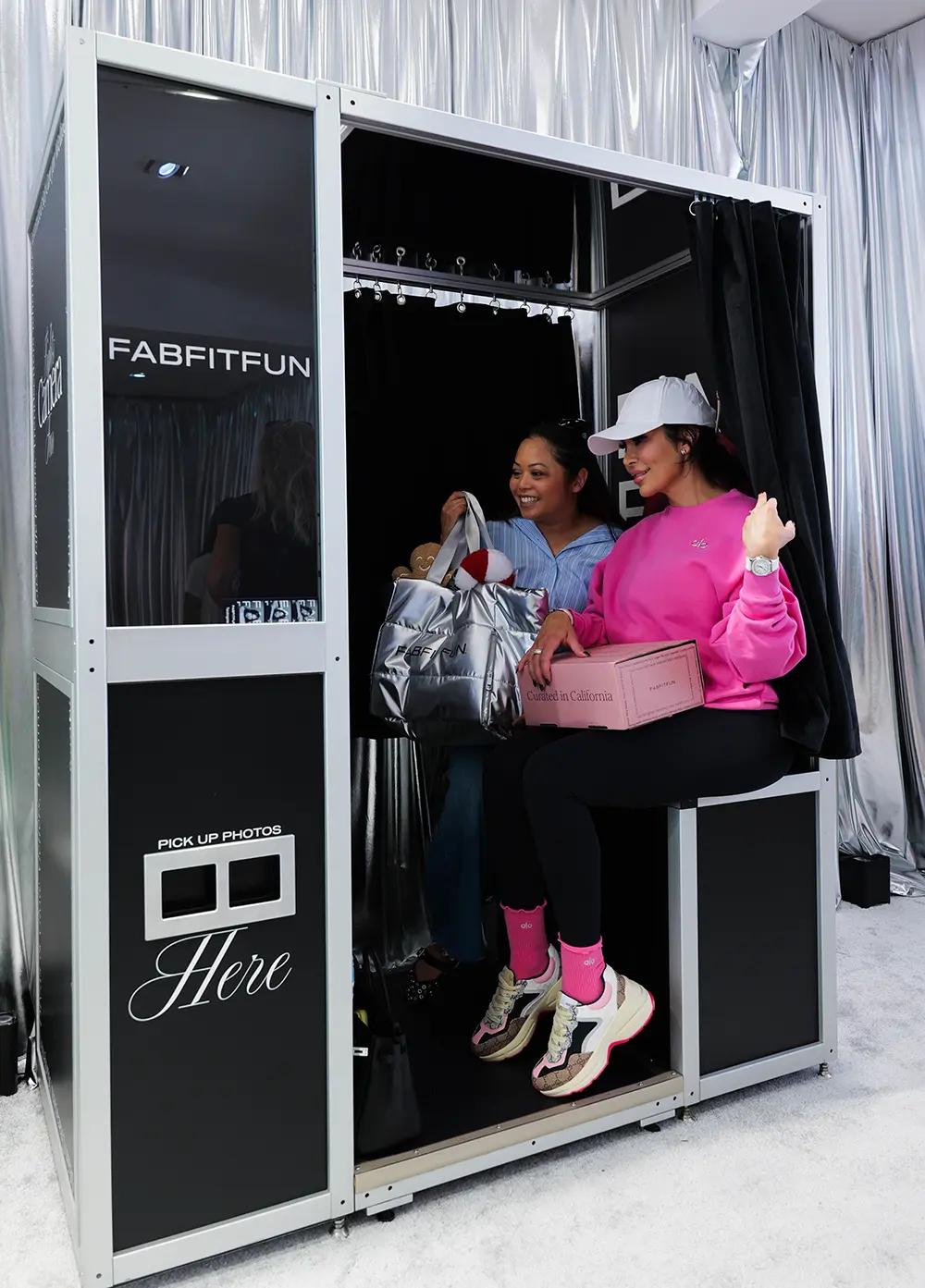
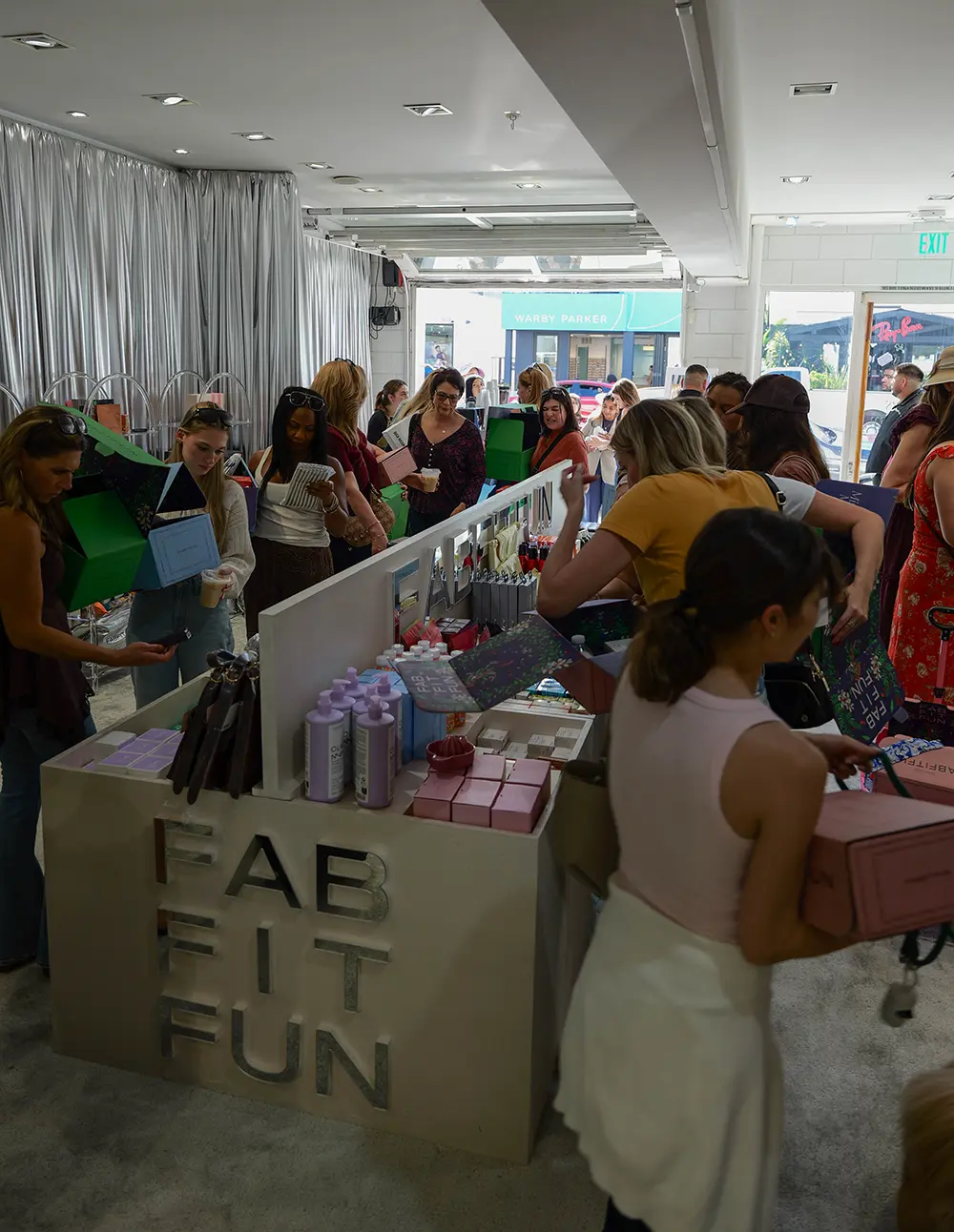
FabFitFun ran a retail pop-up in Los Angeles over three days in November, eleven to four each day. The brand's seasonal box is the thing people know it for, and the pop-up was the physical version of that: tables of product, boxes stacked by color, a crowd moving through an outdoor shopping center with tote bags getting heavier as the afternoon went on.
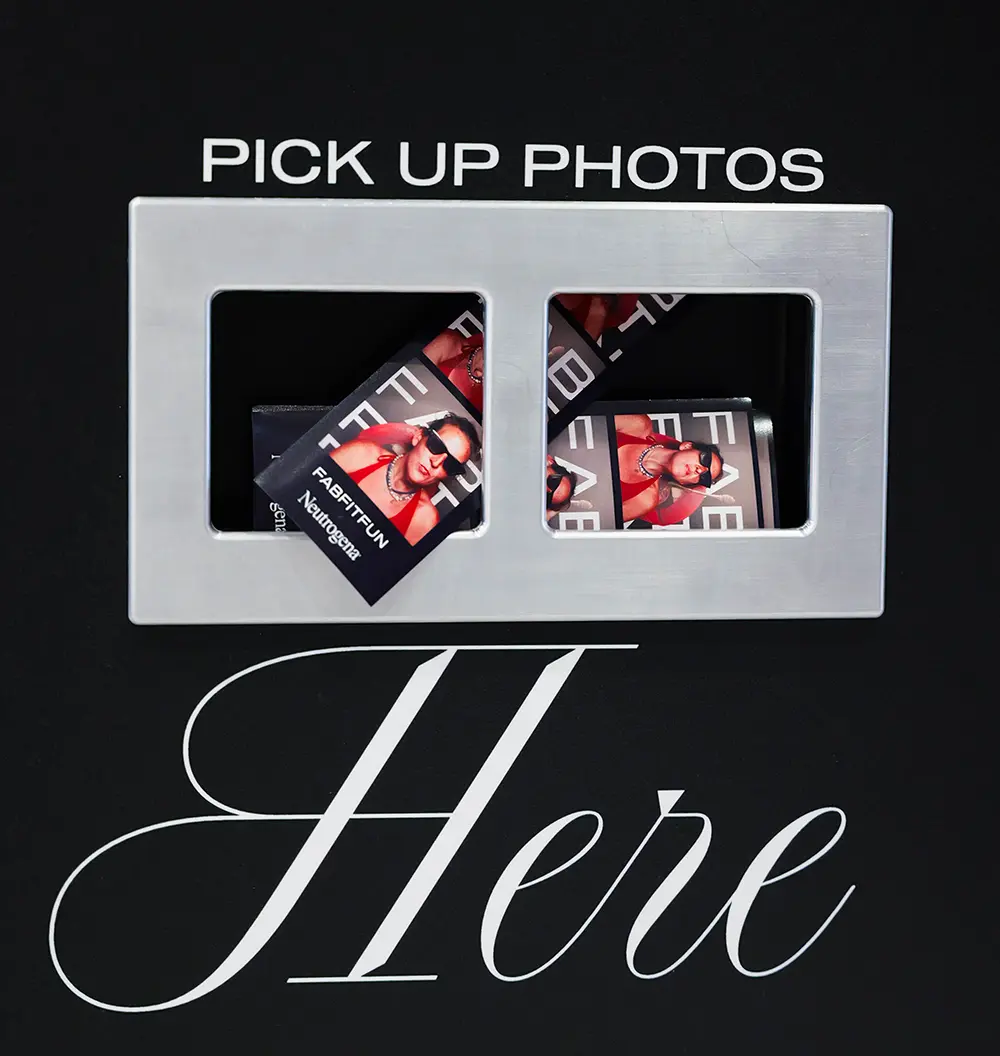
We built the photo booth for it. And the detail worth starting with is that four guests got in at once.
Not two. Four, shoulder to shoulder on the bench, all of them in frame, all of them on the same strip. Here is how we handled this brand activation.
Throughput is a seating question before it is a speed question
When a brand asks whether a photo booth can handle high foot traffic, the assumed answer is about speed. Faster capture, faster print, shorter cycle. Shave the session down and push more sessions through the hour.
That math has a ceiling, and it is a low one. A photo booth session has a floor it cannot go under. Guests need time to get in, settle, read the screen, decide what they are doing with their faces. Compress that and you get worse photos, which defeats the point of the activation. You can take a ninety second session down to seventy five. You cannot take it down to twenty.
The other variable has no ceiling in the same way. If four people ride one session instead of two, the booth served twice as many guests without running a single extra cycle. The line moves at double the rate and nothing about the session got rushed. Nobody had a worse time. They had a better one, because four friends in a booth is funnier than two.
So the design question for a crowded activation is not how fast the booth cycles. It is how many people fit in a cycle, and whether the booth was built for that or merely tolerates it.
Ours was built for it. The bench is deep enough that a back row is a real position and not a person crouching behind someone's shoulder. The opening is wide enough that four people can get in without choreography. The camera sits high and pulls back far enough that four faces are all actually in the frame, which is the part most booths fail. A lot of booths will physically admit four guests and then print a strip with two of them in it. That is not capacity. That is a crowded photo.
The guests figured this out without being told. Nobody put a sign up saying four fits. They looked at the bench, saw room, and brought their friends.
The print tray is the second thing that keeps a line moving
The other place a crowd backs up is not the camera. It is the exit.
In a slow room, the person who shot the session walks around to the slot, waits a few seconds, takes their strip, leaves. Fine. In a crowd, that same ritual is where everything jams, because the next group is already in the booth and the person collecting is standing in the way of the people arriving. Our photo booth negates this effect because our print tray is built with this in mind.
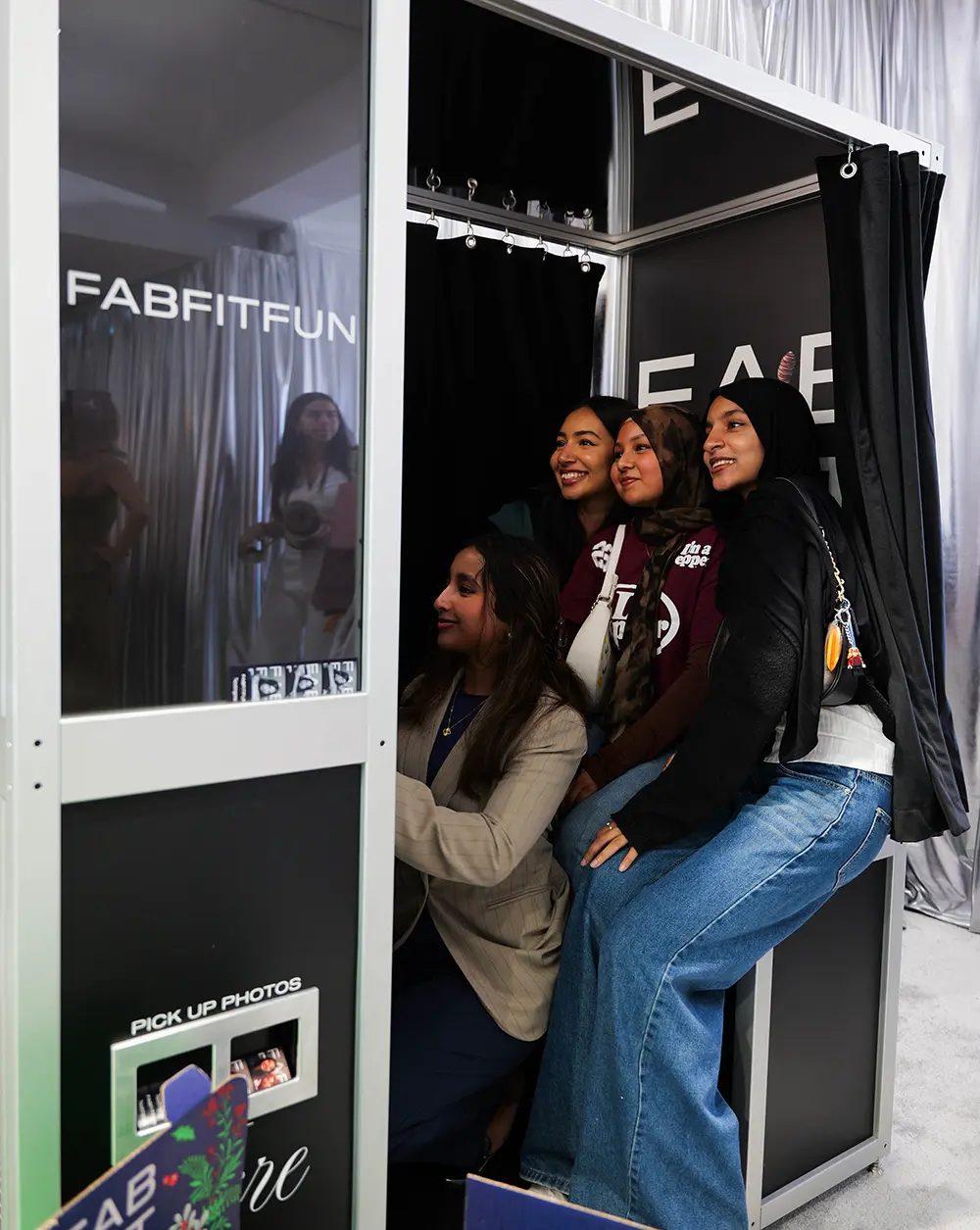
This booth prints into the photo booth shoot, and the slot is big enough to hold a stack. Prints land and wait. The booth keeps shooting and printing whether or not anybody has collected yet, and strips pile up until their owners come back for them. Guests can walk away, go look at the product tables, come back five minutes later, and their strip is sitting there.
That is a buffer, and a buffer is what separates a booth that handles a crowd from a booth that becomes a crowd. Nothing waits on anything else. The capture queue and the collection queue stop being the same queue.
It is also why the panel above the slots reads PICK UP PHOTOS HERE in letters you can see from across the floor. That copy exists because in a busy activation the person standing at the slot frequently is not the person who just shot. They need to be told where to go, by the booth, from a distance, without asking anyone.
What we built
The booth is our Classic, finished for FabFitFun rather than built from scratch. White aluminum frame, black panels, the FABFITFUN wordmark across the top, a mirrored upper panel that let guests check themselves before they sat down. Black velvet curtain on the entrance. A silver lamé backdrop inside that threw light around the cabin and kept the strips bright even with the curtain closed.
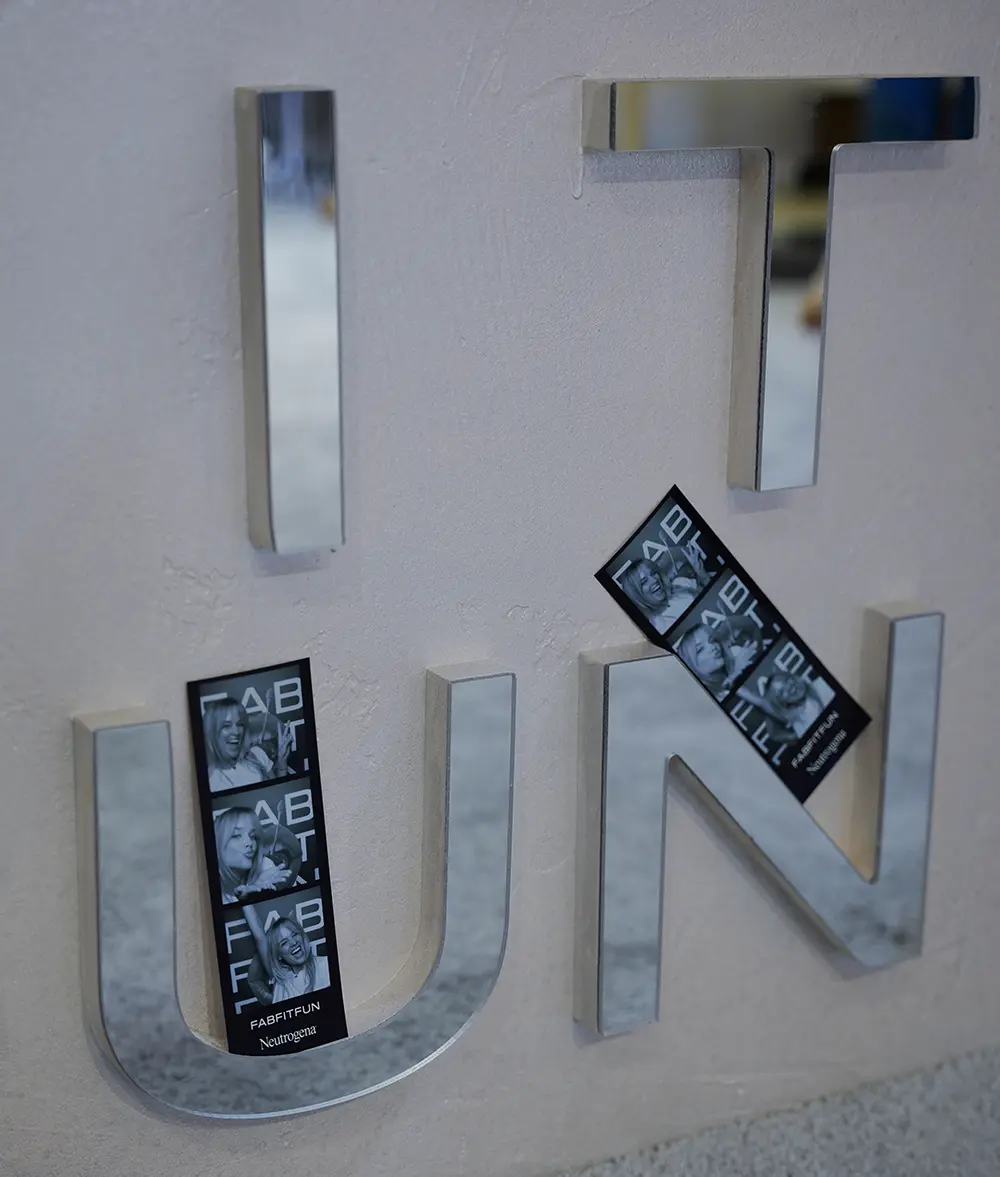
The strip is black, with FAB FIT FUN set as a repeating pattern behind the photos and the wordmark at the footer. Photos in black and white. Against the pink and green of the boxes on the tables, a black strip with white type was the one thing on the floor that did not compete with the product, which is why it photographed well in people's hands. If you like this level of customization for your brand, let’s work together and create unforgettable memories for your next brand activation.
{{button}}
Where this sits
This was a brand activation, which is our short-run work: a booth finished for a brand, on site for a defined window, built around what that brand is doing in that room. It sits alongside our beauty work with Rare Beauty and Summer Fridays, and it is one of a long run of Los Angeles activations where the booth has to hold its own against a busy street or a busy floor.
Volume is familiar ground. H&M Beverly Hills gave us a grand opening crowd, Coach and Versace gave us sustained runs with real numbers behind them, and at Tomato Art Fest the answer to a festival crowd was more booths rather than a bigger one. The answer is not always the same. For a three day pop-up on a fixed footprint, adding cabinets was never on the table, so the capacity had to come out of the one we brought.
For venues that want a booth on the floor permanently rather than for a weekend, that is our Venue Placement program, which works on a different model entirely.
Questions brands ask about booths at busy activations
How many people fit in the booth? Four comfortably, and all four land in the frame. The bench depth, the opening width, and the camera position all have to be right for that to be true, which is why it is worth asking any booth vendor rather than assuming.
Does the booth slow down when it gets busy? No. The session takes the same time for the first guest of the day and the last. Where a busy activation actually backs up is collection, not capture, which is why the print tray holds a stack rather than making each guest wait at the slot for their own strip.
What happens if someone does not pick up their strip right away? It waits in the tray. Guests regularly shoot, walk off to look at product, and come back for the print later. The booth keeps running in the meantime.
Do we need staff standing at the booth? Not for the booth to work. Guests use it the way they use an elevator, by looking at it and getting in. Brands sometimes put a person nearby for product reasons, but that is a brand decision and not a machine requirement.
Should we display sample strips at the activation? Yes, and it is worth doing before doors open rather than waiting for guests to leave their own. People in a line cannot see what a booth produces until they have used it, so putting a few strips somewhere visible lets them evaluate the offer from where they are standing.
How far in advance do you need the artwork? Earlier is better, and the finishing route needs less lead time than a ground-up build. Send us what you have and we will tell you honestly whether the date works.
Does the booth need power and wifi? Power, yes. We will tell you exactly what and where.
Get a booth on your floor
A booth that handles a crowd is not a faster booth. It is a booth with more room in it and somewhere for the prints to wait. If you are planning an activation where the floor is going to be busy, that is the conversation to have early, while the footprint is still being drawn.
{{button}}

